



Every week someone reaches out and asks me the same question:
“Gagan, should I wait? The market looks like it’s crashing.”
I understand why people feel this way. Open any news app or social media feed and the tone is the same everywhere — sales are down, prices have softened, and listings are up. It creates the impression that something fundamentally broke in real estate. But after spending years in this business and watching multiple cycles unfold, I’ve learned that real estate is less emotional than it appears. It’s mathematical. And right now, the math and the headlines are telling two very different stories.
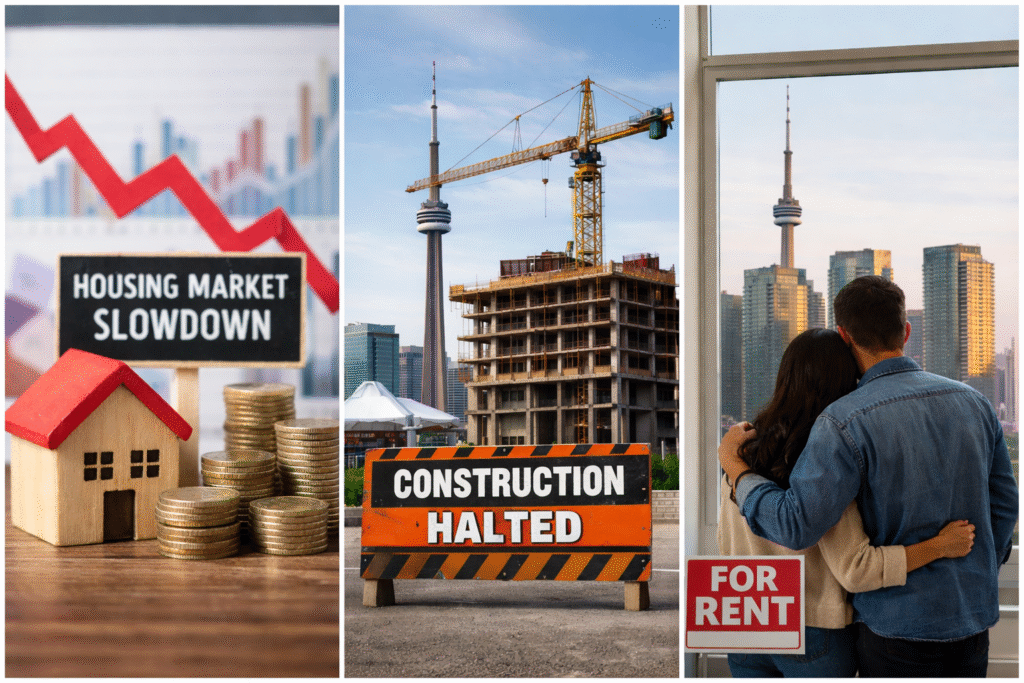
Yes, sales dropped significantly. In fact, the GTA recently saw one of the lowest home-sales periods in more than twenty-five years. That sounds alarming until you add one missing piece: the population is the highest it has ever been. When those two facts sit side by side, the conclusion becomes obvious — people didn’t disappear and housing didn’t become unwanted. People simply stopped making decisions.
Higher interest rates, economic uncertainty, and constant negative messaging caused hesitation. Buyers pressed pause. Not cancel — pause. And when people don’t buy homes, they still need somewhere to live, so they rent. That is exactly what happened across the GTA, where rental activity reached record highs. The demand never left the market; it shifted sideways.
This distinction matters because there are two types of slow markets. One is dangerous — when jobs disappear, population declines, and housing demand structurally weakens. The other is temporary — when confidence drops and people wait for clarity. What we’re experiencing today clearly falls into the second category. Buyers didn’t stop wanting homes; they stopped wanting risk. Historically, confidence always returns faster than housing supply can adjust, which leads to the part of the story most people are not paying attention to.
While buyers paused, builders stopped building.
At the moment, it costs developers roughly over $1,100 per square foot to construct a new condo, yet buyers in the resale market are purchasing closer to $900–$1,000 per square foot. That gap makes projects financially unrealistic. Without profitability there is no financing, and without financing construction does not begin. Since buildings take four to five years to complete, today’s slowdown does not impact today’s inventory — it impacts future inventory.
The result is simple math. The GTA requires roughly forty to fifty thousand new homes each year to keep up with population growth. Based on current construction starts, future supply could drop close to five thousand homes annually later in the decade. This is not a prediction or a theory; it is already locked in because projects that were never started cannot suddenly be delivered in 2029 or 2030. Real estate cycles rarely turn when buyers panic. They turn when supply quietly disappears.
Many people then ask why prices have not collapsed if the market feels so weak. The answer is that housing demand delayed rather than declined. Even during a period of higher rates, record condo completions, and slower population growth, prices corrected modestly compared to expectations. Markets do not fall indefinitely when people still need housing. Instead, they stall, absorb inventory, and then move again once supply tightens.
We are already seeing early signs of stabilization in certain areas. Downtown Toronto has begun to firm up faster than some suburban pockets because construction there slowed earlier and the return-to-office trend is bringing residents back into the core. Real estate historically recovers from the center outward, not the other way around.
For buyers, this environment presents something rare: time to think, options to choose from, and negotiation leverage. But it is important to understand that prices rarely rise first. Activity rises first. By the time the news confidently declares the market “hot” again, the best opportunities are usually gone.
For sellers, the bigger question is not short-term fluctuation but long-term demand. Population growth in Canada continues, housing construction is slowing dramatically, and housing remains essential. Those three forces have historically supported real estate values over time.
So is the Toronto housing market crashing? No. What we are experiencing is a transition period — a confidence slowdown occurring at the same time future supply is quietly shrinking. Markets often feel the most uncertain right before they rebalance. The difference today is that the data already tells us what tomorrow’s inventory will look like, and that understanding changes how we interpret the present.
Real estate decisions should never be based purely on headlines. They should be based on understanding where the market sits within the cycle. If you understand that, the current moment stops looking scary and starts looking strategic.