



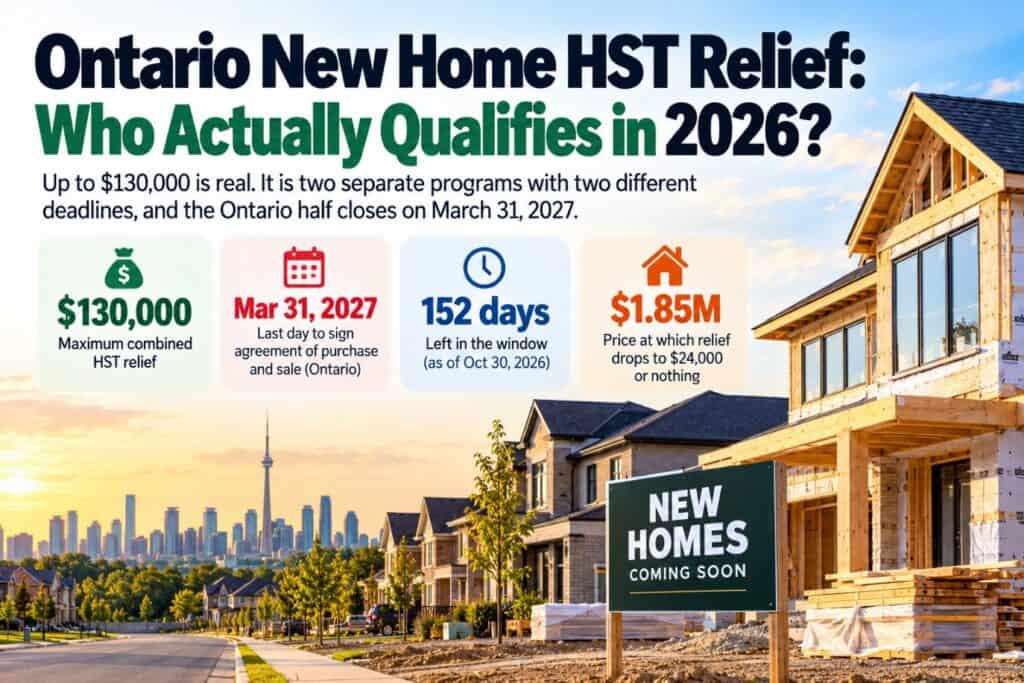
Up to $130,000 is real. It is two separate programs with two different deadlines, and the Ontario half closes on March 31, 2027.
Two programs, one combined maximum, and a window that is already 58% gone.
It is not one rebate. It is three.
Ontario’s page states it plainly: “Eligible buyers could save up to $130,000 through our temporary expanded Harmonized Sales Tax (HST) relief on new or substantially renovated homes.” That figure is correct, but it is the sum of separate pieces that work differently:
- The Ontario enhanced new housing rebate (ENHR) — up to $80,000, covering up to 100% of the 8% provincial portion of HST. Important detail most summaries miss: that $80,000 is the *combined* figure including the existing Ontario new housing rebate of up to $24,000. The old rebate is folded in, not added on top.
- The federal first-time home buyers’ GST/HST rebate — up to $50,000, covering up to 100% of the 5% federal portion, for first-time buyers only.
- The Ontario New Home Affordability Payment (ONHAP) — a top-up of up to $50,000, described by Ontario as “equivalent to up to 100% of the 5% federal portion of HST.” You must first be eligible for and receive the ENHR to get it.
The surprise: first-time and repeat buyers land in the same place
The common assumption is that first-time buyers get materially more. On the total, in the core price range, they do not.
Ontario’s own wording is the reason: “Your ONHAP payment is reduced by the federal portion of any HST rebate that you may be entitled to claim, including the federal HST first-time home buyers’ rebate.” The CRA puts it the same way — claim the federal rebate first, and “if there is any amount related to the 5% federal part of the HST that could not be rebated through the FTHB GST/HST rebate, you may be able to recover that amount through the ONHAP.”
In other words, the ONHAP exists to fill whatever the federal rebate does not. On a $1.25 million home a first-time buyer gets $80,000 provincially, roughly $25,000 federally, and about $25,000 of ONHAP. A repeat buyer gets $80,000 provincially, nothing federally, and $50,000 of ONHAP. Both land on $130,000. What differs is which forms get filed and who pays you — not the money.
Illustration at $1.25 million. Calculated from the published bands, not an official worked example.
Where the money actually peaks — and where it falls off a cliff
Below $1 million the relief is simply 13% of the price — 8% provincial plus 5% federal — so an $800,000 home attracts about $104,000, not $130,000. The maximum is reached at exactly $1 million.
Then something counterintuitive happens. Between $1 million and $1.5 million the relief does not phase down. It is flat. Ontario’s table reads “flat amount of $50,000” for the ONHAP and the CRA’s reads “flat rebate of $80,000” for the ENHR across that whole band. A $1.45 million home attracts the same $130,000 as a $1.0 million one.
Between $1.5 million and $1.85 million there is “partial relief” — and Ontario publishes no formula for it. At $1.85 million and above, the CRA says only “the Ontario new housing rebate of up to $24,000 is available.” That is a drop of more than $100,000 across a threshold. If a builder’s price is anywhere near $1.85 million, that number deserves scrutiny before you sign.
Calculated on consideration excluding HST. The partial band is not quantified by Ontario.
The deadline that is about to bite
This is the single most important thing on this page. The two programs have completely different windows.
The federal first-time rebate requires an agreement of purchase and sale entered into “on or after March 20, 2025, and before 2031.” Five more years.
The Ontario programs require an agreement “on or after April 1, 2026, and on or before March 31, 2027.” That is a twelve-month window, and as at today roughly 152 days remain. Sign on April 1, 2027 and you still qualify federally — and you lose up to $80,000 of provincial relief plus the ONHAP.
There are construction deadlines too, and they also differ. For the Ontario rebate on a builder purchase, construction must have begun on or before December 31, 2028 and be substantially completed on or before December 31, 2031. Federally, construction must begin before 2031 and be substantially completed before 2036. On a long-dated Caledon pre-construction release, the Ontario completion date is the one that can fail.
Assignments are tightly restricted. For the Ontario rebate, “both the initial agreement of purchase and sale with the builder and the assignment agreement must be entered into between April 1, 2026, and March 31, 2027.” Both ends inside the same twelve months. Most assignment inventory on the market today will not clear that test.
Agreement date windows. Construction and completion deadlines differ again.
Why the advertised savings are not a cheque
Builders will market this relief hard, and the number on the sign will be the maximum. Five things decide whether you see it:
It must be your home. The rule is that you are “purchasing or constructing the home for use as the primary place of residence for you or your relation (cannot be used as a rental property),” and you or your relation must be “the first individual to occupy the home.” Investor pre-construction purchases do not qualify.
The builder usually takes it. Where the builder “pays or credits” the rebate to you, the builder files the application and the amount is netted into the price. You do not receive a payment. If the price already reflects the rebate, the rebate is not a discount on that price — it is the reason for it.
You must consent to information sharing. The ONHAP has no separate Ontario application — it rides on the CRA rebate form. Ontario warns that if you do not consent to share your information, “the Ontario Ministry of Finance may contact you and your payment may be delayed.”
First-time status is strictly defined. You must be at least 18, a Canadian citizen or permanent resident, and must not have lived in a home you or your spouse owned “at any time in the calendar year or in the previous four calendar years” — anywhere in the world. Neither you nor your spouse can have received the rebate before.
If the builder does not credit it, you file — and the clock runs. You have two years from the date ownership transfers.
The local picture
The relief applies to new and substantially renovated homes, not resale, but the resale market is the backdrop every builder is pricing against. In September, Caledon recorded 64 sales at an average of $1,070,154 with 6.6 months of inventory and an average sale at 95% of asking — against 4.7 months and 97% in Brampton. Caledon homes took 63 days on market versus 53 in Brampton.
Caledon is the softest market in Peel on every one of those measures. A builder release there is competing with resale inventory that is already discounting. That is worth knowing before you treat an advertised HST saving as the whole of the negotiation.
TRREB Market Watch, September 2026. Resale transactions.
| QUESTIONS TO ASK BEFORE YOU SIGN
“Is the advertised price before or after the rebate?” If the builder is crediting the rebate, it is already in the number and there is no cheque coming. Get this in writing on the statement of adjustments, not in conversation. “What is the consideration excluding HST?” Every threshold — $1 million, $1.5 million, $1.85 million — is measured on consideration excluding HST, not the all-in number on the sign. A home advertised near $1.85 million can sit on the wrong side of a $100,000 cliff. “When will construction begin and be substantially complete?” The Ontario rebate requires construction to have begun by December 31, 2028 and to be substantially complete by December 31, 2031. Get the builder’s scheduled occupancy in writing and compare it to that date, with room for slippage. “Who files, and what happens if I am denied?” If the builder credits the rebate and the CRA later disallows it, the contract decides who is on the hook. Have your lawyer read that clause before you waive conditions. If you are buying to rent it out, stop here. The relief requires the home to be the primary residence of you or a relation and requires you to be the first occupant. A rental purchase falls under a different rebate entirely. If you are close to the line on first-time status, check the four-year rule carefully. It looks back over the current calendar year plus the previous four, counts ownership anywhere in the world, and includes your spouse. It does not change your total in the $1M to $1.5M band — but it changes which program pays you and when. |
Sources
OFFICIAL AND PRIMARY SOURCES
- Government of Ontario — The Ontario New Home Affordability Payment. Published September 17, 2026. Source of the $130,000 combined figure, the $50,000 ONHAP maximum and the relief bands. https://www.ontario.ca/page/ontario-new-home-affordability-payment
- Canada Revenue Agency — Ontario enhanced new housing rebate. Source of the $80,000 maximum, the agreement window and the construction deadlines. https://www.canada.ca/en/revenue-agency/services/tax/businesses/topics/gst-hst-businesses/gst-hst-rebates/housing-rebates/ontario-enhanced-new-housing.html
- Canada Revenue Agency — What is the Ontario enhanced new housing rebate. Source of the rebate band table and the $24,000 figure. https://www.canada.ca/en/revenue-agency/services/tax/businesses/topics/gst-hst-businesses/gst-hst-rebates/housing-rebates/ontario-enhanced-new-housing/what-rebate.html
- Canada Revenue Agency — Who can apply for the Ontario enhanced new housing rebate. Source of the agreement dates, assignment rule and primary-residence conditions. https://www.canada.ca/en/revenue-agency/services/tax/businesses/topics/gst-hst-businesses/gst-hst-rebates/housing-rebates/ontario-enhanced-new-housing/who-can-apply.html
- Canada Revenue Agency — First-time home buyers’ GST/HST rebate. https://www.canada.ca/en/revenue-agency/services/tax/businesses/topics/gst-hst-businesses/gst-hst-rebates/first-time-home-buyers-gst-hst-rebate.html
- Canada Revenue Agency — What is the first-time home buyers’ rebate. Source of the $50,000 maximum and the $1.25 million worked example. https://www.canada.ca/en/revenue-agency/services/tax/businesses/topics/gst-hst-businesses/gst-hst-rebates/first-time-home-buyers-gst-hst-rebate/what-rebate.html
- Canada Revenue Agency — Who can apply for the first-time home buyers’ rebate. Source of the four-year look-back and the age and residency conditions. https://www.canada.ca/en/revenue-agency/services/tax/businesses/topics/gst-hst-businesses/gst-hst-rebates/first-time-home-buyers-gst-hst-rebate/who-can-apply.html
- Canada Revenue Agency — Home purchased from a builder. Source of the pay-or-credit rules, the Royal Assent reference and the two-year filing deadline. https://www.canada.ca/en/revenue-agency/services/tax/businesses/topics/gst-hst-businesses/gst-hst-rebates/first-time-home-buyers-gst-hst-rebate/how-apply/home-purchased-from-builder.html
- Canada Revenue Agency — Guide RC4028, GST/HST New Housing Rebate. https://www.canada.ca/en/revenue-agency/services/forms-publications/publications/rc4028/gst-hst-new-housing-rebate.html
- Toronto Regional Real Estate Board — Market Watch, September 2026. Source of the Caledon, Brampton and Peel Region resale figures. https://trreb.ca/wp-content/files/market-stats/market-watch/mw2609.pdf
Gagan Verma, Royal LePage Signature Realty · 30 Eglinton Avenue West, Mississauga, Ontario
General information prepared for discussion. Not tax, legal or financial advice, not a determination of eligibility for any program, and not an Opinion of Value for any specific property. Program rules and figures are current as of October 30, 2026 and may change. Not intended to solicit buyers or sellers currently under contract with another brokerage.