



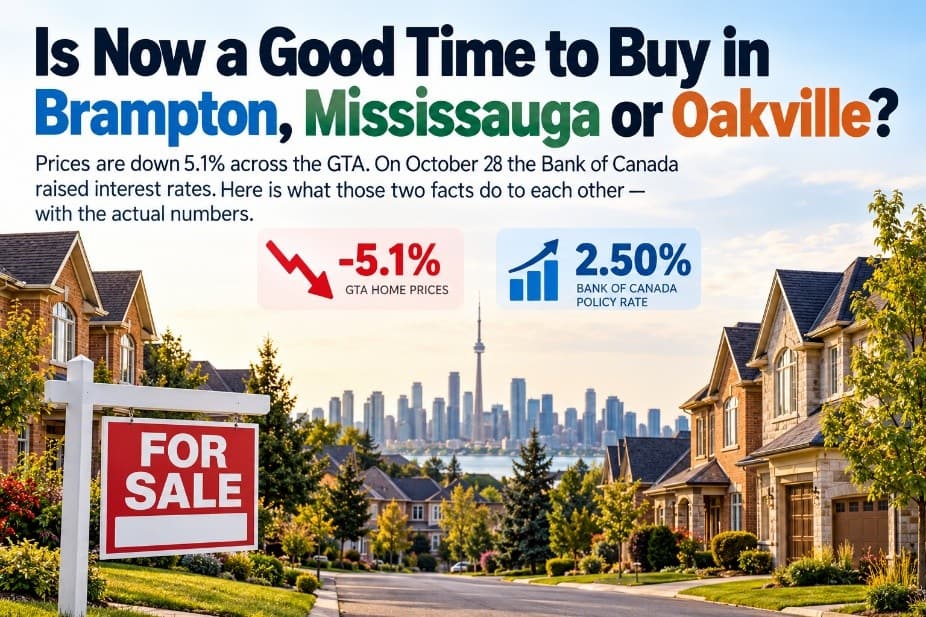
Prices are down 5.1% across the GTA. On October 28, the Bank of Canada raised interest rates. Here is what those two facts do to each other — with the actual numbers.
What September actually showed
TRREB’s September Market Watch reported 5,040 GTA sales, down 9.0% from a year earlier, and an average selling price of $1,006,409, down 5.1%. The MLS Home Price Index benchmark, which adjusts for what kind of homes sold, was down 4.7%. Those are the numbers in the headlines, and they are correct.
The number that did not make the headlines matters more if you are buying. New listings fell 14.4% — to 16,500 from 19,270. Active listings fell 9.3%. Sellers are stepping back from this market faster than buyers are. Months of inventory sat at 4.6 and the average sale came in at 98% of the asking price. That is a balanced market, not a fire sale.
TRREB’s own Chief Information Officer, Jason Mercer, described it this way: buyers “want to take advantage of today’s more affordable housing market, but they need to be confident that their employment situation will remain solid and inflation will not put pressure on borrowing costs over the long term.”
Two days ago, borrowing costs moved. The Bank of Canada raised its policy rate by 25 basis points to 2.50% on October 28, and said “there could be a need to increase the policy rate further.” The conventional five-year mortgage rate it publishes has already gone from 6.09% at the end of September to 6.19%, and the five-year Government of Canada bond yield that fixed mortgage pricing follows rose to 3.62% on the day of the decision.
The three cities are in the same market
This is the part most buyers get wrong. Brampton, Mississauga and Oakville are not three different market conditions you can shop between. In September they were almost identical: months of inventory of 4.7, 4.8 and 4.9, and sale-to-list ratios of 97%, 97% and 96%.
What differs is price. Across all home types the average was $854,322 in Brampton, $929,600 in Mississauga and $1,365,169 in Oakville. For detached houses specifically: $1,001,613, $1,285,467 and $1,740,421. An Oakville detached house costs 74% more than a Brampton one.
So the question is not which city has the better timing. The timing is the same in all three. The question is which price point fits what you can carry — and that is a different conversation.
TRREB Market Watch, September 2026.
Buy now or wait? Here is the math
Suppose you are looking at an average-priced Brampton home at $854,322, with 20% down and a 25-year amortization. At the Bank of Canada’s published five-year rate of 6.19%, principal and interest come to roughly $4,450 a month.
Now suppose you wait a year and prices fall another 5%. The home costs $811,606 and your mortgage is $649,285. If rates have not moved, your payment is $4,228 — you save $223 a month. That is the case for waiting, and it is real.
But if rates rise half a point while you wait, that payment becomes $4,424. You have saved $26 a month on a house that cost $43,000 less. If rates rise a full point, you pay $4,624 — $174 a month more than if you had bought today, on the cheaper house. A 5% price drop is roughly a 50-basis-point rate move. That is the whole trade.
Nobody knows which way rates go. The Bank’s next scheduled decision is December 9, 2026, and it has told you it may raise again. What this math says is not “buy now” — it is that a price forecast on its own is not a reason to wait, because the rate you get is at least as powerful as the price you pay, and you control neither.
Urban Land Group calculation on TRREB and Bank of Canada figures. Illustration, not a quote.
What you can actually negotiate
The average September sale closed at 97% of asking in Brampton and Mississauga, and 96% in Oakville. Applied to the average prices, that implies roughly $26,000 of room in Brampton, $29,000 in Mississauga and $57,000 in Oakville between list and sale.
Two honest caveats. That gap is measured against the current list price, which on a property that has already been reduced is not the original ask. And it is an average — a well-priced house in a good pocket still sells near list, while an overpriced one that has sat for 50-plus days has far more room. Property days on market averaged 53 in Brampton, 56 in Mississauga and 56 in Oakville, so there is more standing inventory to work with than there was two years ago.
The more valuable leverage right now is usually not price. It is conditions — financing, inspection, status certificate review, and closing date. In a market at 4.7 months of inventory, those are negotiable in a way they were not in 2021, and they protect you in ways a few thousand dollars does not.
What you need upfront
CMHC’s rules set the minimum down payment at 5% of the first $500,000 and 10% of the portion above it, and mortgage loan insurance is only available where the purchase price is below $1,500,000.
On September’s average prices that means roughly $60,400 in Brampton, $68,000 in Mississauga and $111,500 in Oakville across all home types. For detached houses, $75,200 and $103,500 in Brampton and Mississauga.
Oakville detached is the exception, and it is a big one. At an average of $1,740,421 the home is above CMHC’s $1.5 million ceiling, so an insured mortgage is not available at all. That means a conventional mortgage and a minimum 20% down — about $348,084. Buyers often discover this late. If Oakville detached is the target, the down payment is the constraint, not the price.
One more cost that gets missed: on an insured mortgage the premium itself is a percentage of the loan and can usually be added to the mortgage, but in Ontario the provincial sales tax on that premium cannot be — it has to be paid in cash at closing.
TRREB prices against CMHC requirements. Down payment figures are calculated, not quoted.
The closing cost nobody budgets for
Ontario land transfer tax runs 0.5% on the first $55,000, 1.0% to $250,000, 1.5% to $400,000 and 2.0% above that. On September’s, averages that is $13,561 in Brampton, $15,067 in Mississauga and $23,778 in Oakville.
If you have never owned a home anywhere in the world, the province refunds up to $4,000 — enough that a qualifying first-time buyer pays no land transfer tax on the first $368,000 of price. You must be at least 18, occupy the home as your principal residence within nine months, and be a Canadian citizen or permanent resident. Apply within 18 months of registration.
And here is the quiet advantage of buying in these three cities rather than downtown: buyers in the City of Toronto pay a second, municipal land transfer tax on top of the provincial one. Brampton, Mississauga and Oakville buyers pay the provincial tax only.
Government of Ontario rates applied to TRREB’s September 2026 average prices.
Sources
OFFICIAL AND PRIMARY SOURCES
- Toronto Regional Real Estate Board — Market Watch, September 2026. Released October 6, 2026. Source of all sales, price, listing, inventory and days-on-market figures. https://trreb.ca/wp-content/files/market-stats/market-watch/mw2609.pdf
- TRREB — Market Watch index page. https://trreb.ca/market-data/market-watch/
- Bank of Canada — Policy rate decision, October 28, 2026. Target for the overnight rate raised 25 basis points to 2.50%. Next decision December 9, 2026. https://www.bankofcanada.ca/2026/10/fad-press-release-2026-10-28/
- Bank of Canada — Key interest rate and schedule. https://www.bankofcanada.ca/core-functions/monetary-policy/key-interest-rate/
- Bank of Canada — Conventional 5-year mortgage rate, series V80691335, week of October 21, 2026. https://www.bankofcanada.ca/valet/observations/V80691335/json?recent=4
- Government of Ontario — Calculating Land Transfer Tax. Source of the rate brackets. https://www.ontario.ca/document/land-transfer-tax/calculating-land-transfer-tax
- Government of Ontario — Land Transfer Tax Refunds for First-Time Homebuyers. Source of the $4,000 maximum and the eligibility conditions. https://www.ontario.ca/document/land-transfer-tax/land-transfer-tax-refunds-first-time-homebuyers
- City of Toronto — Municipal Land Transfer Tax rates and fees. Confirms the second, municipal tax applies to properties in the City of Toronto. https://www.toronto.ca/services-payments/property-taxes-utilities/municipal-land-transfer-tax-mltt/municipal-land-transfer-tax-mltt-rates-and-fees/
- CMHC — General requirements to qualify for homeowner mortgage loan insurance. Source of the down payment rules and the $1,500,000 maximum. https://www.cmhc-schl.gc.ca/consumers/home-buying/mortgage-loan-insurance-for-consumers/what-are-the-general-requirements-to-qualify-for-homeowner-mortgage-loan-insurance
- CMHC — Mortgage loan insurance cost. Source of the premium rates and the Ontario sales tax note. https://www.cmhc-schl.gc.ca/consumers/home-buying/mortgage-loan-insurance-for-consumers/cmhc-mortgage-loan-insurance-cost
Gagan Verma, Royal LePage Signature Realty · 30 Eglinton Avenue West, Mississauga, Ontario
General market information prepared for discussion. Not financial, mortgage, tax or legal advice, and not an Opinion of Value for any specific property. Figures are current as at October 30, 2026 and change. Not intended to solicit buyers or sellers currently under contract with another brokerage.